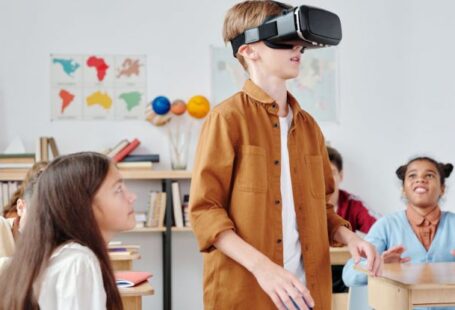
The integration of technology in education has revolutionized the way students learn and teachers instruct. One of the latest advancements in this field is mixed reality, a powerful tool that combines elements of both virtual reality (VR) and augmented reality (AR). By merging the physical and digital worlds, mixed reality offers a unique and immersive learning experience that enhances student engagement and understanding. In this article, we will explore how mixed reality is transforming education and why it is considered the best of both worlds.
Enhancing Immersion and Engagement
One of the key benefits of mixed reality in education is its ability to enhance immersion and engagement. By overlaying digital content onto the physical environment, students can interact with virtual objects and scenarios in a realistic and immersive way. This hands-on approach to learning not only captivates students’ attention but also helps them retain information better. For example, in a history class, students can use mixed reality to explore ancient civilizations or witness historical events firsthand, making learning more engaging and memorable.
Fostering Collaboration and Interaction
Another advantage of mixed reality in education is its capacity to foster collaboration and interaction among students. By creating shared virtual spaces where students can work together on projects or simulations, mixed reality promotes teamwork and communication skills. This collaborative learning environment allows students to exchange ideas, solve problems, and engage in meaningful discussions, enhancing their social and cognitive development. Moreover, mixed reality can connect students from different locations, enabling them to collaborate in real-time regardless of physical distance.
Personalizing Learning Experiences
Mixed reality also offers the opportunity to personalize learning experiences according to students’ individual needs and learning styles. By adapting content and challenges based on students’ progress and performance, mixed reality can provide a tailored learning experience that meets each student’s unique requirements. For example, in a language learning setting, mixed reality can offer interactive exercises that adjust difficulty levels based on students’ proficiency, ensuring optimal engagement and skill development. This personalized approach to learning can help students achieve better outcomes and boost their confidence and motivation.
Simulating Real-World Scenarios
One of the most powerful applications of mixed reality in education is its ability to simulate real-world scenarios that are otherwise difficult or impossible to recreate in a traditional classroom setting. By immersing students in realistic simulations and scenarios, mixed reality enables them to apply theoretical knowledge to practical situations, enhancing their problem-solving and critical thinking skills. For instance, in a science class, students can conduct virtual experiments in a safe and controlled environment, allowing them to explore scientific concepts and principles through hands-on practice.
Preparing Students for the Future
In today’s rapidly evolving digital world, it is essential for students to develop skills that will prepare them for the future workforce. Mixed reality in education equips students with technological literacy, critical thinking, creativity, and collaboration skills that are increasingly in demand in the job market. By integrating mixed reality into the curriculum, educators can ensure that students are not only academically proficient but also well-prepared to navigate the complexities of the 21st-century workplace.
Embracing the Future of Education
Mixed reality represents the future of education, offering a transformative learning experience that combines the best of both virtual and physical worlds. By enhancing immersion, fostering collaboration, personalizing learning experiences, simulating real-world scenarios, and preparing students for the future, mixed reality has the potential to revolutionize the way we teach and learn. As educators and institutions continue to embrace this innovative technology, the possibilities for enhancing education are limitless. Mixed reality truly embodies the best of both worlds, bridging the gap between the traditional classroom and the digital age.