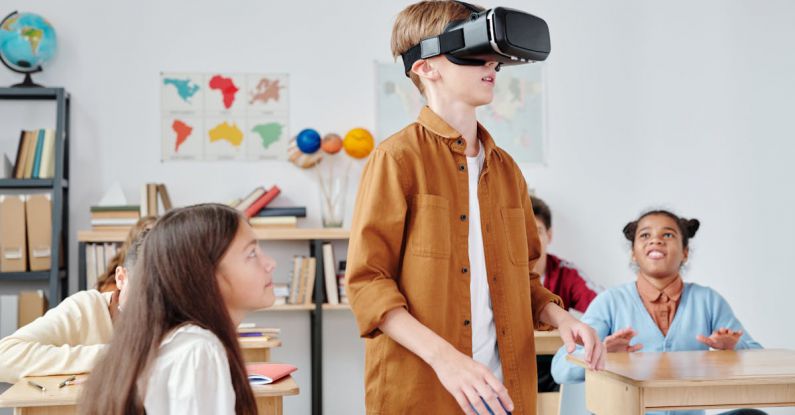
In recent years, virtual reality (VR) technology has made significant strides in various industries, including education. This innovative technology has the potential to revolutionize the way students learn by providing immersive and interactive experiences that bridge the gap between theoretical knowledge and practical application.
Enhancing Learning Experiences
One of the key advantages of incorporating virtual reality into education is its ability to enhance learning experiences. Traditional methods of teaching often rely on textbooks, lectures, and demonstrations to convey information to students. While these methods are effective to a certain extent, they can fall short when it comes to engaging students and making learning more interactive and memorable.
Virtual reality offers a solution to this problem by creating virtual environments that can simulate real-world scenarios. For example, students studying biology can explore the human body in 3D, allowing them to see how different systems work together in a way that is not possible with traditional teaching methods. This hands-on approach not only increases students’ understanding of complex concepts but also makes learning more engaging and enjoyable.
Practical Application of Theoretical Concepts
Another benefit of using virtual reality in education is its ability to bridge the gap between theoretical concepts and practical application. Many subjects, such as engineering, architecture, and medical sciences, require students to understand theoretical principles and apply them in real-world scenarios. Virtual reality provides a platform for students to test their knowledge in a safe and controlled environment, allowing them to make mistakes and learn from them without any real-world consequences.
For example, engineering students can use virtual reality simulations to design and test structures before building them in the physical world. This hands-on experience not only reinforces theoretical concepts but also develops critical thinking and problem-solving skills that are essential for success in the field.
Promoting Collaboration and Communication
Virtual reality also promotes collaboration and communication among students and educators. In a traditional classroom setting, students often work independently on assignments and projects, with limited opportunities for interaction with their peers. Virtual reality changes this dynamic by allowing students to collaborate on projects in a virtual space, regardless of their physical location.
By working together in virtual environments, students can share ideas, brainstorm solutions, and provide feedback to each other in real-time. This collaborative approach not only enhances the learning experience but also prepares students for the teamwork and communication skills they will need in the workplace.
Empowering Personalized Learning
One of the most significant advantages of virtual reality in education is its ability to empower personalized learning. Every student has unique learning preferences and abilities, and virtual reality can cater to these individual needs by providing customized learning experiences.
Educators can use virtual reality to create personalized learning environments that adapt to each student’s pace and learning style. For example, students who struggle with visualizing geometric shapes can use virtual reality simulations to manipulate and interact with 3D models, making abstract concepts more tangible and easier to understand.
Conclusion: Revolutionizing the Future of Education
Virtual reality has the potential to revolutionize the future of education by bridging the gap between theory and practice, enhancing learning experiences, promoting collaboration, and empowering personalized learning. As this technology continues to evolve and become more accessible, educators have the opportunity to transform the way students learn and prepare them for the challenges of the 21st century. By embracing virtual reality in education, we can create a more engaging, interactive, and effective learning environment that equips students with the skills they need to succeed in a rapidly changing world.